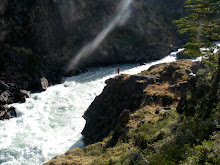
Heather, Todd and I needed to check out all of the rivers for the Wet Planet itinerary. Following their airport hell, we drove to the Sarapiqui River, putting in at Pozo Azul Adventure Center. The putin below the bridge revealed more water than my last trip down, but still pretty rocky. We were all pretty happy to be on the water after the 3 hour drive from the airport to the Northern plains of Costa Rica.(Photo coming soon)
From the bridge you can see the first rapid. The river goes through a shallow boulder garden before dropping over a jumble of rocks toward the right wall. At low water the rapid is very shallow and you need to bash over many of the rocks as you go.
The river goes along for a bit before the next rapid. In this one, the whole river splits around an island. Go left and dodge the rocks and holes down this chute. Right down the middle is good, and there's a sweet boof over the hole half way down. (Photo coming soon) Below this rapid after the river reconnects there is a beautiful blue pool where you can often find local kids swimming.
About 1km downstream is the Class III rapid, Rocky Road. This is obvious as the river bends right and crashes into a large rocky wall. There are a few holes and rocks close to the wall, so you need to ferry left away from the wall to stay out of them. The rock wall may be slightly undercut, so stay off it. (Photo coming soon)
A bit down from this rapid is the Class III+ Superman. This rapid is obvious when the river has a small gravel bar with a large Y-shaped tree growing in the middle of the river. The channel splits here, and you need to go right of the tree. There is a narrow chute with a hole on the left side, so right is better. Down below the chute is a hidden rock at lower water that is too easy to crash into. Keep an eye out down below for this. (Photos coming soon)
The Sarapiqui then begins what we named The S Turns. This section has a number of bends that terminate in undercut walls, some with, some without pillows. All of the walls should be approached with caution, as they are undercut and are deceivingly powerful.(Photo coming soon)
The river splits again a bit downstream, and you can go either way. Left is good with a narrow channel that drops in next to a wall. Riding the pillow off this wall is fun, and there's another fun wave when it remeets the other channel.(Photo coming soon)
From here down its all good till the takeout. The takeout is on the river left under the first hanging bridge. There is a small parking area here, but don't leave your car here unattended. There are some crazy kids here who will try to take your stuff or dance around like monkeys. Weird.
This is an easy shuttle to hitch hike, and the people at Pozo Azul are super cool and will likely let you leave your car in their parking lot if you ask. Walk from the takeout 100m to the main road. Hitchhike to your left back to Hacienda Pozo Azul. The Tent Camp at Pozo Azul is reasonable and a nice place to crash for boating. Highly recommended. They also have a sweet canopy tour and other activities.
This is a fun stretch of river, especially with more water. After the run, we booked it up to the 28 foot Pozo Azul waterfall to check it out.(photos coming soon)
Monday, March 12, 2007

The Money Shot
I was sitting on a Pacific beach (Playa Avallanes) about a week ago watching the sun set into the ocean. As the sun was dropping down toward the ocean, I saw a ship sailing across the horizon line. I was told it was a tourist ship that sails daily from Tamarindo down to Puntarenas, sort of a sunset cruise. As the sun got closer to the horizon line, the ship got closer to the sun. About 10 minutes before sunset I started joking with the owner of the restaurant, "How crazy would it be if the sun set into the ship?" As the sun hit the horizon, this is what we saw... The owner said it was the first time in 18 years he had seen it like this...
About 3 minutes before...

"The Money Shot"

About 3 minutes before...

"The Money Shot"

Thursday, February 22, 2007
El Angel de La Noche

Every 90 days I need to leave Costa Rica to renew my visa. For this reason I decided to head across to Nicaragua for a short vacation. There are two border crossings, Penas Blancas and San Carlos. The San Carlos crossing passes close to a friend´s stables, so after a few days of horseback I headed north towards the border.
The Wednesday started around 7am, walking to the bus that was supposed to arrive around 7:30. I was there in time, around 7:15, but then realized that I needed US$ to cross the border. (here begins the first of a few problems, as will unfold). I took out $40, which I thought would be enough to get me rolling in NIC. I then ran back to the 7:30 bus which proceeded to never come. Bummer.
So I sat on my pack on the side of the road until 8:50, when the 8:30 bus arrived. The bus was packed as usual, so I took my normal position, standing in the center isle, head tilted because all the Ticos are too short to make the buses any taller. Fortunately, the bus was on a pretty good road, so all was well. Well, almost well... When we arrived in Los Chiles, the border town, I walked down to the customs and immigration offices to leave the country. The entrance to NIC and boat (the only passage is by boat on the Rio San Juan) cost 7700 Colones ($17US), more than expected. No worries, I still had my trusty $40US for NIC.
The boat from Los Chiles to San Carlos was also packed, and when the lady at immigration told me that it left at 12, she actually meant be there at 11:30, otherwise you´ll be sitting on the floor. You can imagine my surprise when I found out that not only was my seat taken, but the boat couldn't leave (fortunately, because it would have left me) because the police officer checking life jackets had decided that there weren't enough. Not that it would matter since the river is full of crocodile and Cayman.

Once the policeman was satisfied with the life jacket count (read=bribe), the boat slowly headed up the river towards San Carlos de Nicaragua. The boat was small, too small for the 41 passengers (ascertained by the PFD count). There were many Nicaraguans as well as Costa Ricans, going to visit friends and family. On the boat I met Julia, a traveling photojournalist who is writing a guidebook on CR and NIC for a German publisher. She also speaks Hungarian, Spanish, French, English, and German... so we had lots to talk about. Coincidentally, she was headed to San Carlos to renew her visa, and also lives in Turrialba. Her plan was to take the boat to San Carlos in the afternoon, and return on the evening boat, only leaving the country for a few hours, rather than 3 days as required. She told me it had worked at every other border, and it did here too.
Arriving in San Carlos by boat from Costa Rica is like walking into a different world. San Carlos is a far outpost of NIC, and is only accessible by boat from Granada (12 hours) or road from Managua (8 hours, allegedly). The town itself lies on the far south east end of Lago de Nicaragua. There is actually a water passage that goes from the Pacific, up the rivers to San Carlos, across the lake, and out on another river to the Atlantic. If the journey didn't take a few days to do, the Panama Canal might have never been built. Because the area was originally colonized by the Spanish, there are a number of Spanish Castles and fortifications that still exist in the town and the surrounding areas. The town is quaint but an echo of the past, quiet but alive.


Upon arrival in San Carlos, you need to pay for your entrance into NIC ($7US). Unfortunately, Julia had forgotten to get her US$ (she should have checked the guide book) so I agreed to sell her my $20US for Colones. I did this not fully realizing that there is no way to get money in San Carlos, and that the only accepted currency is $US or the $NIC, Cordoba. We entered San Carlos to find the next big surprise: The boat for Granada only leaves on Tuesdays and Fridays. Bummer. To relax a bit and figure stuff out, Julia and I go to a place she knows to grab a bit to eat. The place has changed a bit and now costs $6US.
The situation as it stands: I'm in Nicaragua with $7US, a few thousand Colones, and have no boat to get where I need to go for 2 days. The solution: There is a bus to Managua for $6US that isn't as nice as the boat ride, but will get me there in 8 hours, leaving at 6, 8, and 10pm. Perfect, so I can take the bus to Managua, get more cash from an ATM, jump on another bus to Granada and be there well rested from the bus rides to enjoy the day. Simple.
I go to the ticket office (read=guy looking official at the bar) and surrender my last few dollars for a bus ticket to Managua. I figure I can take the 6pm bus, landing me there around 2am. I could sleep a bit in the bus station until the buses leave for Granada, then on to there.
I needed to kill a few hours in San Carlos, which isn't a very big place, so after my third walk around town I decided to settle into the local fruit and vegetable market. I walked up and down the stalls until I found some people who looked nice, then asked them if I could sit down and watch them peel carrots and chayote for a salad. We talked for a few hours about all sorts of marvelous things. After a half hour or so, the guy began asking me about homosexuality in the US, and what people think about it. A few minutes later he confessed that he was homosexual, and that so were his other few friends who had been stopping by. It turns out that San Carlos is a bit of a Leper-Colony for homosexuals in Nicaragua. Although the population is small, the outpost has a reputation for that. I said goodbye to my new friends at the market who sent me along with tomatoes, mandarins, and salad for my overnight bus journey.
As I approached the buses at the terminal, I had a bit of an 'oh shit' moment. There were two buses parked at the Managua terminal. One was a newer looking yellow school bus, freshly washed, 'School Bus' still painted across the top. The other was a white painted bus, cerca 1975, with the words 'El Angel de La Noche' stencilled across the top of the windshield, like the bus was squinting to see you. I thought, 'This is the bus that Chris McCandless found in Alaska, as told by John Krakauer in Into the Wild.' It ends here. As I came around the front of the buses, I was relieved to see 'Managua, 6pm' scribbled on the window of the yellow bus. So, it doesn't end here.


Right on time, 6pm sharp the yellow bus jumped to life, and the dozen passengers of this midnight rider boarded. There was a sentiment on the bus of, 'I'd like being anywhere but here for the next 8 hours' as we backed out of the terminal. We started to bump down the coblestone roads heading out of San Carlos. After a few minutes the bus stopped to pickup some school children walking home and I thought, 'This road really isn't so bad'. A few minutes later, at the edge of San Carlos we let the children off, and the road ended. Literally, ended.
To say the next 8 hours were some of the longest of my life is an understatement. This road could have been a minefield, a golfcourse with sandtraps and ponds, a battlefield and trenches after a war, a 4x4's paradise. And I got a big yellow school bus. There were places where the potholes were so big, all 4 wheels would enter the hole before any left. The bus tossed and turned, side to side, end to end like a restless person with a fever. After 2 hours, I thought, this road couldn't possibly be like this for all 8 hours... It wasn't, for two reasons: First, the bus didn't make it. Second, it took almost 12 hours in total.
After hour 6, we stopped so the driver could have a smoke. The bus never started again. My beautiful, yellow, newish school bus had failed me. We sat for an hour and a half trying various things to get the bus to turnover. No dice. During the time the bus wouldn't start, I got out and walked around a bit in the night. It was black, pitch black. There were a million stars and no light. We really were in the middle of nowhere. Looking at the map of Nicaragua, one notices that there is nothing east of the lake. No roads, towns, nothing. We were stuck in the middle of nothing.


Through the night came a rumble and then lights. It was 'El Angel de La Noche.' We all boarded the bus, and rumbled on into the night, leaving behind the crippled yellow bus. A few hours later around 5am, we arrived in Managua, the capitol city of Nicaragua. I waited till dawn, got on a local bus to the other bus station, got on a bus to Granada, and slept the whole way there. I've never been so happy to be on a bus. The paved rode lulled me to sleep in minutes, and I woke up in Granada, where I am now.
Sitting here, now in Grenada, NIC, its hard to believe the journey I have traveled in the past 36 hours. I don't believe in Angels, but last night I was saved by one... the one I didn't believe in. Perhaps, a story for living better.
Friday, February 09, 2007
Cerro Chirripó, Round Deux
On a moments notice, I decided it was a good idea to give Cerro Chirripo a second shot. After my first trip up the tallest peak in Costa Rica, I had decided it was probably going to be my first and last climb. The weather had been miserable, the trail muddy and steep, and the view, well, somewhat disappointing. All this set aside, I took the invite from Ashley, Shamus, and Ben to join them for their first climb.
We arrived around 3:55 in San Isidro to find out we were just in time to miss the 4 o'clock bus to San Gerardo, the base town for climbing Chirripo. A little put out, we decided to try and hitch up to the town. We walked a few km out of San Isidro, and got on the road to Rivas. We figured we might end up sleeping on a soccer field somewhere, or walking the 25km to town. To our surprise, we were almost immediately picked up by a very nice farmer who was headed all the way to San Gerardo, what luck! About half way up we stoped on the roadside next to a cliff. The farmer got out and picked up a box that sitting next to Ben. "Todo bien?" I asked. The farmer grinned and said, "Un perro... se murio" as he tossed the box off the cliff... I guess that's how they bury dogs in Costa Rica. We were beside ourselves.


We hadn't made reservations to make the climb, and upon arriving found out that they were REQUIRED! Being the stubborn travelers we are, we went to the ranger station at 5am, just to make sure that there hadn't been some mistake, or that no one had canceled. Turns out that they sell 10 spaces per day on a first come basis, so we got our tickets to go... around 7am... In the meanwhile Ben and I tried the local fruit (not advised) and saw on a poster the kind of wildlife to expect in the park...


The trailhead for the hike is right around 5,000 feet. Each kilometer of the hike has a different name and title for the kilometer. In honor of the system, we took pictures at each of the markers with our own interpretation of the signage. Enjoy.

 Shamus struggling with the first few steps


We were gifted beautiful weather for the entire trip, and soaked up the high elevation sun. We also did a sunrise summit hike, summiting at least an hour before sunrise, freezing our asses off for an hour until sunrise, and then booking down in search of warmer weather. We did manage to pose for a sunrise YMCA...


Saturday, December 23, 2006
Snow in Costa Rica
 Three days before Christmas I was traversing San Jose through the central mall. The streets were packed with busy shoppers and peddlers selling their goods. It was the hustle and bustle that you might find the week before Christmas in the US as well.
Because Costa Rica lies close to the equator, the average yearly temperature is around 76 degrees. The weather rarely drops into the 60s, even high in the mountains. There is no snow here, making the prospect of a white Christmas seem comical. That said, they still sell snow frosted trees, rain deer pulling sleighs and snow globes.
Part of the holiday ritual in San Jose is to make it a white Christmas. There are hundreds of vendors in the streets selling white paper confetti. I was in a hurry, so as I bustled through the mall, I hoped to avoid the white snowflakes being tossed around. As I got close to the center of town, the crowd got denser, and the snow got thicker. It was literally snowing, and there was no way to avoid it.
As I stepped around a group of kids, I got hit with my first snowball. I wasn't ready for it, and had my mouth agape as the confetti filled my hair, shirt, and nose. I coughed, inhaling the little pieces of paper as another hit me, this time in my ear. Then another and another. I was being assaulted by confetti. People would walk up to me, look for a second and then douse me with another handful of paper. By the time I got to the bus, I was a walking snowman.
It is these small differences and beams of light that make Costa Rica such a wonderful place to be. A ritual where assaulting others with handfulls of confetti in the US would land you in jail or start a fight. The ideology that community is a thing of the past is killing the light spirt and enjoyment of life in our society. Who would have thought that a bag of confetti could unify a community, and create a white christmas where there is no snow.
Tuesday, December 05, 2006
Spin to Win v2.0
The last 'Spin to Win' post had to do with spinning my mind, and cycling. This one is about spinning a different kind of wheel.
Driving in Costa Rica is pretty much insane. There are a number of different factors that contribute to this general level of insanity. First, its the laws and the lack of personnel to enforce them. Most of the traffic laws here are the same as in the states: Obey stop signs, yield, no passing zones, ect.. However they are all merely suggestions. There are very few traffic cops to enforce the laws, and most of the officers that are on the roads are easily bribed out of writing you a ticket. The tickets are inexpensive (16US$ for DUI), so there really is not much incentive to follow them.
Second, the drivers. The Costa Ricans are fanatical drivers. They must get where they are going as fast as possible using the path of least resistance. To this end, they will drive on sidewalks, in the wrong lanes, or create new lanes, if it will get them there faster. It is not uncommon to get passed by busses going uphill around blind corners on dirt roads on your left side on the shoulder!
Third, it is the poor quality of the roads that crisscross around and through the mountains and jungles that dot the Costa Rican landscape. Many of the roads are paved with many potholes, unpaved with many potholes, or are only roads by the virtue of the last 10 people who drove there to get around the person in front of them. This story is about this aspect of the Costa Rican driving experience.
I was at Centaura (my company's horse stables) this morning after flying the hot air balloon over the Jungle with Esteban. Some of the guys had gone to the upper field to bring back horses for the clients who were riding in the afternoon. I had just missed them, and Esteban suggested I take Rosita (Tucker's infamous red Land Cruiser) up to the upper pasture. I also took with me Danny (cause he knew where we were going), and Paul (cause he was caught in the crossfire). We started up the hill toward the field, and a lot of the ground was muddy... Not just muddy puddle muddy, but slippery red clay and muck muddy. Rosita slid a bit, but managed to cruise over the level but slippery ground. It was similar to driving on snow.
When we got to the hill, there was a trickle of reddish water coming down the hill along with the guys who went to get the horses. They didn't need our help, but we decided to go up to the upper pasture anyway, just to see it and check out the horses. As we began to climb the muddy road, the tires spun a bit as red clay shot out the bottom of the Land Cruiser. The road went up gradually with clay over rocks for a bit before turning sharply upward and around a corner, banked and graded to the left. The wheels began to spin out and the cruiser lost control and power I floored to climb the steeper section of road. The road was already rutted out from others spinning their wheels, and the mud splattered everywhere as I floored it, hoping to regain traction and make the move up the hill. The tires screeched and spun, but the car wasn't going any further up the hill. Disappointed that we'd have to walk the last 100m, I slowly rolled the car backwards down the hill. This is when gravity took over.
Next thing I knew, the car was sliding sideways across the road (remember, the road was graded). As the car slid hopelessly into the ditch I spun the tires, a last chance to save the car from the small streambed roadside. The car tilted sideways as the left tires dropped into the chasm. We were stuck. Very stuck. For more than an hour, the three of us stuffed anything we could find under the wheels to create traction, to no avail. Finally, we radioed back to base that we were going to need some help.
They came in force. Three guys, a Land Rover 4x4, and a lot of will. They began trying to climb the hill I was unable to. It was nerve racking watching their vehicle climb the same path, get stuck and then almost roll backwards into Rosita. They tried that at least 4 times before deciding that the car wouldn't climb the hill, period. This was encouraging because at least they couldn't climb it either! Watching them spin their wheels, I didn't feel quite as stupid about landing the car off the road. After an hour of wheel spinning, rubber burning, mud slinging, car pushing, people pulling fun in the mud, we decided on two things: 1) We couldn't do it, 2) The Land Rover was almost out of gas.
A few of us headed back for more fuel while two of the younger guys stayed with Rosita. Getting gas in Costa Rica is quite difficult. Stations are few and far in between. An hour and a half later when they returned with gas, Rosita followed close behind. After we left, the two younger guys (neither had drivers licenses) read the instruction manual on Rosita and figured out how to use the winch and positraction, two very useful tools when you are stuck in the mud. The kids were so proud of themselves, it was good to see such spirit. I will never live this one down with Tucker. It is part of the ritual. Every young, male, non-Costa Rican guide she has ever had has gotten the car stuck one way or another. At least I didn't roll it, crash it, or damage it in any sort of permanent way. Of course, I do have 5 more months...

Saturday, December 02, 2006
Spin to Win
With 2 weeks of Spanish school under my belt, my head hurts. Every day of Spanish school was easily more difficult than any one day of school I ever had at UPS. My daily schedule was strictly regimented to keep me from going completely nuts. As follows:
(Early morning hours, maybe roused by the occasional earthquake, four in two weeks)
7:30- Wakeup with Mama Tica knocking on my door
7:40- breakfast (1st cup of coffee)
7:50- Walk 5 minutes to school (2nd cup as entering building)
8:00- Class starts with conversation and new topic of the day (3rd cup as the bell rings)
10:00- Descanso (10 minute break for minisnack and more coffee)
10:20- Return to class with head spinning (on to 4th or 5th cup)
12:00- Break for lunch, discuss with friends how difficult Spanish school is at our favorite lunch spot, Soda Olivia. Soda Olivia is owned by a crazy woman named Tommy who speaks at least 5 languages, and is fluent in English with a strong NY accent. Her husband Carlos runs the place where they serve the best Casado (CR cuisine at its finest, rice, beans, meat, and salad) in Costa Rica for less than $2US. After lunch, I have 2 hours of conversation class where all of the head hurting and learning seems to pay off, and I continue to discover how much I don't know in the language.
3:00- Class is over. I usually lay in a hammock for a good 15 minutes to decompress before heading home to do homework and cook with my family. Although I've been sitting all day, I am tired like I've just worked a full day on the river.
After a week of classes I was having a hard time sleeping, and was feeling really tired all the time. I decided, on a whim, to check out the exercise options in San Joaquin de Flores. It turns out spinning is the workout craze in Costa Rica. Spinning involves a group of people working out together on stationary bicycles. Its like any group exercise, except the trainer is constantly changing the music, lights, and pace of the workout. I was instantly hooked. During my second week of classes, I never missed a workout. Every day at 5pm, I'd head down to Spin City for an hour session. The workout is especially interesting in a language you don't know. All of the encouragement and enthusiasm of the instructor becomes whatever you imagine it to be. Mind mind often wandered to crew, or the girls spinning next to me.
My family in San Joaquin was fabulous! My parents were Nidia (pron=Kneedeeahh) & Miquel, and their two kids Jimmy (16) and Jason (21). They were very welcoming from the first day to the last day, and always made sure I had enough to eat. Nidia lives at home, and the family hosts students mostly because she enjoys the company. They spoke virtually no English which made coming home both interesting and difficult. They invited me to come back to their house for Christmas and tamales (the CR Christmas specialty). I am sure I will.
Subscribe to:
Posts (Atom)