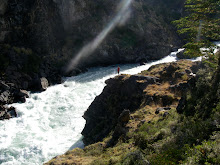
The Toro flows far below the silver bridge that crosses it between Aqua Zarcas and San Miguel. Unfortunatley, from here down the pig farm nearby contaminates the water, making it a less satisfying whitewater experience. However, for those who are willing to brave the "Caca Cascade", it is a section full of wonderful whitewater (brown water).
The rapids are similar to the Recreo Verde section, but not as steep, and not as continuous. There are still some tight turns and boulder gardens to be had. The fist 30 minutes in this section took getting used to the pig smell, but after that, the river was back to fun again! (photos coming soon)
About an hour down from the bridge is a great lunch spot. It is on a river right beach with a small hut on the shore. I think it may be commercial, but there wasn't anyone there when we passed through. Nothing like a warm beach to enjoy tortillas with tuna fish and chicky's. Below here is a rapid that has a log sticking out across the right side of the river. You can duck under it or go hard left.
About halfway down this run the character of the run changes dramatically. The canyon opens up, and it goes to "small bigwater" boating. The holes get a bit bigger and the river seems to double in size and volume. The open plains are a welcome change and it is surprising that the gradient continues with quality whitewater, even though the river is open and out of the canyon. There is also the drone of the chicadees that can be deafening. Its amazing that such small animals can make so much noise with their legs.
We were floating down this open pastured section when we noticed a monkey in a tree. Closer inspection revealed that there was a whole family of them, and that they were as interested in the small colorful things in the river as we were in them. Its this kind of wildlife and experiences that make Costa Rica such a fun place to be. (photo coming soon)
Tuesday, March 13, 2007

2/12/2007 - Rio Toro - Recreo Verde Section
Todd, Heather and I had wanted to run the Class V Casa Maquinas section of the Rio Toro. We had also met a Tico, Raulio, the previous day who came with us for the ride. Todd ran it years ago and we wanted to go check it out. The putin is at the Rio Toro Dam II, about 10km up a very steep road, indicative of incredible gradient in the run! The scene at the dam is surreal: The dam was built deep in the Rio Toro canyon. The walls rise vertically over your head, and water tumbles down hundreds of feet to the valley floor. The huge hydroelectric plant is dwarfed by the immensity of this place. Its an experience just to be there. Unfortunately, we weren't able to run this part of the Toro on this day. (photos of canyon and fun nazi coming soon).
ICE (the Costa Rican power/ telecommunications monopoly) was doing work on the dam with some heavy machinery. The guard (read=fun nazi) told us that only people wearing jackets and helmet were allowed to enter the construction zone. We agreed to wear our helmets and PFDs but the guard, who also had a gun, was not amused. So we snapped some photos, tried to find another way to the river, tried to bribe the gaurd, turned around, and headed 3 miles downstream to the Class IV Recreo Verde section of the Toro. We'll be back for the Casa Maquinas another day. (photos of dam project coming soon)
The Recreo Verde gets its name from the put in at the Recreo Verde Hotsprings. We were charged 1000 colones ($2) per person to use their river access. This seemed steep, but we didn't really have another option. The Toro river is a mineral rich river, similar to the Rio Sucio. For this reason, the Toro is a brown-yellow color all the time. Although it looks very dirty, it is actually quite clean (until the pig farm... more on that later).
The Toro River canyon is quite deep, and very isolated. Although the section of river is Class III+-IV, the commitment makes it more intimidating. The walls rise up hundreds of feet above the river bed, and vines and jungle cover the walls for as far as the eye can see. It is true Costa Rica boating. (photos coming soon)
The river runs fast and gives continuous Class III-IV rapids and boulder gardens for the first few miles. Although there are few distinct rapids, there are many that run one into another, keeping the pace fast and interesting. If there is any one character of this section, its that every wall that the water hits at the bottom of each rapid is undercut. We all managed well, but it seemed like most of the run was spent avoiding undercut walls. It was great fun!
The first significant rapid is a drop on the right side that goes over some big rocks and through a big hole. At the bottom it goes into an undercut wall (of course). In general starting near the walls and paddling away from them was most effective.
The river has a cave formation on the left side as it bends right and drops through a steeper boulder garden. There was a log on the right side of the channel, making the left ideal. Super fun move off the wall on the left. (photo coming soon)
One of the coolest things about the Toro is that the walls have lots of small waterfalls and drips coming down them. Many of them are thermals, and thus have warm water coming out of the walls. It seemed like the water in the river got warmer as we headed downstream, almost the opposite of the Green Truss of the White Salmon, which gets colder as the underground springs come into it.(photo coming soon)
There are numerous boulder gardens and fun small drops as you go, too numerous to remember. They were all good to go, and would be a total blast with a bit more water. About a mile downstream there is an old stone bridge over the river. Below this is a waterfall on river left, and a few hundred meters later is the first and only portage on the river. It comes as the river widens and the canyon opens and there is a huge boulder in the middle of the river. There are many small channels that cascade down sideways, and all of them terminate in jumbles of rocks. The best thing to do is paddle up on one of the islands in the rapid and carry your boat across it to the lower left channel, thereby walking the "jumbles of rocks". At higher water staying left from the top is an option, but at low water that route closes out. (photo coming soon)
Next up is the boof rapid. This has a big boulder with a ramp of water running up on it. You can charge this ramp and fly over the top of it. Don't go right to the side of it or you might drop into the narrow slot with a piton rock at the bottom. (photo coming soon)
About 1 km below this rapid is the bridge, signaling the end of the Recreo Verde section. Most people combine this with the Lower Rio Toro, as we did. The bridge is the putin for the lower as well as the takeout for the upper. It is noted that there is a HUGE pig farm on the river right side of the bridge, and from this point down, you must be careful to limit the amount of water that you get in your mouth, eyes, ears, ect... I'd also recommend noseplugs for at least a mile (maybe more) below the farm. Yuck. (photo coming soon) The lower section that we paddled below here can be found in the Lower Trip Report.
ICE (the Costa Rican power/ telecommunications monopoly) was doing work on the dam with some heavy machinery. The guard (read=fun nazi) told us that only people wearing jackets and helmet were allowed to enter the construction zone. We agreed to wear our helmets and PFDs but the guard, who also had a gun, was not amused. So we snapped some photos, tried to find another way to the river, tried to bribe the gaurd, turned around, and headed 3 miles downstream to the Class IV Recreo Verde section of the Toro. We'll be back for the Casa Maquinas another day. (photos of dam project coming soon)
The Recreo Verde gets its name from the put in at the Recreo Verde Hotsprings. We were charged 1000 colones ($2) per person to use their river access. This seemed steep, but we didn't really have another option. The Toro river is a mineral rich river, similar to the Rio Sucio. For this reason, the Toro is a brown-yellow color all the time. Although it looks very dirty, it is actually quite clean (until the pig farm... more on that later).
The Toro River canyon is quite deep, and very isolated. Although the section of river is Class III+-IV, the commitment makes it more intimidating. The walls rise up hundreds of feet above the river bed, and vines and jungle cover the walls for as far as the eye can see. It is true Costa Rica boating. (photos coming soon)
The river runs fast and gives continuous Class III-IV rapids and boulder gardens for the first few miles. Although there are few distinct rapids, there are many that run one into another, keeping the pace fast and interesting. If there is any one character of this section, its that every wall that the water hits at the bottom of each rapid is undercut. We all managed well, but it seemed like most of the run was spent avoiding undercut walls. It was great fun!
The first significant rapid is a drop on the right side that goes over some big rocks and through a big hole. At the bottom it goes into an undercut wall (of course). In general starting near the walls and paddling away from them was most effective.
The river has a cave formation on the left side as it bends right and drops through a steeper boulder garden. There was a log on the right side of the channel, making the left ideal. Super fun move off the wall on the left. (photo coming soon)
One of the coolest things about the Toro is that the walls have lots of small waterfalls and drips coming down them. Many of them are thermals, and thus have warm water coming out of the walls. It seemed like the water in the river got warmer as we headed downstream, almost the opposite of the Green Truss of the White Salmon, which gets colder as the underground springs come into it.(photo coming soon)
There are numerous boulder gardens and fun small drops as you go, too numerous to remember. They were all good to go, and would be a total blast with a bit more water. About a mile downstream there is an old stone bridge over the river. Below this is a waterfall on river left, and a few hundred meters later is the first and only portage on the river. It comes as the river widens and the canyon opens and there is a huge boulder in the middle of the river. There are many small channels that cascade down sideways, and all of them terminate in jumbles of rocks. The best thing to do is paddle up on one of the islands in the rapid and carry your boat across it to the lower left channel, thereby walking the "jumbles of rocks". At higher water staying left from the top is an option, but at low water that route closes out. (photo coming soon)
Next up is the boof rapid. This has a big boulder with a ramp of water running up on it. You can charge this ramp and fly over the top of it. Don't go right to the side of it or you might drop into the narrow slot with a piton rock at the bottom. (photo coming soon)
About 1 km below this rapid is the bridge, signaling the end of the Recreo Verde section. Most people combine this with the Lower Rio Toro, as we did. The bridge is the putin for the lower as well as the takeout for the upper. It is noted that there is a HUGE pig farm on the river right side of the bridge, and from this point down, you must be careful to limit the amount of water that you get in your mouth, eyes, ears, ect... I'd also recommend noseplugs for at least a mile (maybe more) below the farm. Yuck. (photo coming soon) The lower section that we paddled below here can be found in the Lower Trip Report.
Monday, March 12, 2007
3/12/2007 - Rio Sarapiqui, Upper
Heather, Todd and I needed to check out all of the rivers for the Wet Planet itinerary. Following their airport hell, we drove to the Sarapiqui River, putting in at Pozo Azul Adventure Center. The putin below the bridge revealed more water than my last trip down, but still pretty rocky. We were all pretty happy to be on the water after the 3 hour drive from the airport to the Northern plains of Costa Rica.(Photo coming soon)
From the bridge you can see the first rapid. The river goes through a shallow boulder garden before dropping over a jumble of rocks toward the right wall. At low water the rapid is very shallow and you need to bash over many of the rocks as you go.
The river goes along for a bit before the next rapid. In this one, the whole river splits around an island. Go left and dodge the rocks and holes down this chute. Right down the middle is good, and there's a sweet boof over the hole half way down. (Photo coming soon) Below this rapid after the river reconnects there is a beautiful blue pool where you can often find local kids swimming.
About 1km downstream is the Class III rapid, Rocky Road. This is obvious as the river bends right and crashes into a large rocky wall. There are a few holes and rocks close to the wall, so you need to ferry left away from the wall to stay out of them. The rock wall may be slightly undercut, so stay off it. (Photo coming soon)
A bit down from this rapid is the Class III+ Superman. This rapid is obvious when the river has a small gravel bar with a large Y-shaped tree growing in the middle of the river. The channel splits here, and you need to go right of the tree. There is a narrow chute with a hole on the left side, so right is better. Down below the chute is a hidden rock at lower water that is too easy to crash into. Keep an eye out down below for this. (Photos coming soon)
The Sarapiqui then begins what we named The S Turns. This section has a number of bends that terminate in undercut walls, some with, some without pillows. All of the walls should be approached with caution, as they are undercut and are deceivingly powerful.(Photo coming soon)
The river splits again a bit downstream, and you can go either way. Left is good with a narrow channel that drops in next to a wall. Riding the pillow off this wall is fun, and there's another fun wave when it remeets the other channel.(Photo coming soon)
From here down its all good till the takeout. The takeout is on the river left under the first hanging bridge. There is a small parking area here, but don't leave your car here unattended. There are some crazy kids here who will try to take your stuff or dance around like monkeys. Weird.
This is an easy shuttle to hitch hike, and the people at Pozo Azul are super cool and will likely let you leave your car in their parking lot if you ask. Walk from the takeout 100m to the main road. Hitchhike to your left back to Hacienda Pozo Azul. The Tent Camp at Pozo Azul is reasonable and a nice place to crash for boating. Highly recommended. They also have a sweet canopy tour and other activities.
This is a fun stretch of river, especially with more water. After the run, we booked it up to the 28 foot Pozo Azul waterfall to check it out.(photos coming soon)
From the bridge you can see the first rapid. The river goes through a shallow boulder garden before dropping over a jumble of rocks toward the right wall. At low water the rapid is very shallow and you need to bash over many of the rocks as you go.
The river goes along for a bit before the next rapid. In this one, the whole river splits around an island. Go left and dodge the rocks and holes down this chute. Right down the middle is good, and there's a sweet boof over the hole half way down. (Photo coming soon) Below this rapid after the river reconnects there is a beautiful blue pool where you can often find local kids swimming.
About 1km downstream is the Class III rapid, Rocky Road. This is obvious as the river bends right and crashes into a large rocky wall. There are a few holes and rocks close to the wall, so you need to ferry left away from the wall to stay out of them. The rock wall may be slightly undercut, so stay off it. (Photo coming soon)
A bit down from this rapid is the Class III+ Superman. This rapid is obvious when the river has a small gravel bar with a large Y-shaped tree growing in the middle of the river. The channel splits here, and you need to go right of the tree. There is a narrow chute with a hole on the left side, so right is better. Down below the chute is a hidden rock at lower water that is too easy to crash into. Keep an eye out down below for this. (Photos coming soon)
The Sarapiqui then begins what we named The S Turns. This section has a number of bends that terminate in undercut walls, some with, some without pillows. All of the walls should be approached with caution, as they are undercut and are deceivingly powerful.(Photo coming soon)
The river splits again a bit downstream, and you can go either way. Left is good with a narrow channel that drops in next to a wall. Riding the pillow off this wall is fun, and there's another fun wave when it remeets the other channel.(Photo coming soon)
From here down its all good till the takeout. The takeout is on the river left under the first hanging bridge. There is a small parking area here, but don't leave your car here unattended. There are some crazy kids here who will try to take your stuff or dance around like monkeys. Weird.
This is an easy shuttle to hitch hike, and the people at Pozo Azul are super cool and will likely let you leave your car in their parking lot if you ask. Walk from the takeout 100m to the main road. Hitchhike to your left back to Hacienda Pozo Azul. The Tent Camp at Pozo Azul is reasonable and a nice place to crash for boating. Highly recommended. They also have a sweet canopy tour and other activities.
This is a fun stretch of river, especially with more water. After the run, we booked it up to the 28 foot Pozo Azul waterfall to check it out.(photos coming soon)
The Money Shot
I was sitting on a Pacific beach (Playa Avallanes) about a week ago watching the sun set into the ocean. As the sun was dropping down toward the ocean, I saw a ship sailing across the horizon line. I was told it was a tourist ship that sails daily from Tamarindo down to Puntarenas, sort of a sunset cruise. As the sun got closer to the horizon line, the ship got closer to the sun. About 10 minutes before sunset I started joking with the owner of the restaurant, "How crazy would it be if the sun set into the ship?" As the sun hit the horizon, this is what we saw... The owner said it was the first time in 18 years he had seen it like this...
About 3 minutes before...

"The Money Shot"

About 3 minutes before...

"The Money Shot"

Thursday, February 22, 2007
El Angel de La Noche

Every 90 days I need to leave Costa Rica to renew my visa. For this reason I decided to head across to Nicaragua for a short vacation. There are two border crossings, Penas Blancas and San Carlos. The San Carlos crossing passes close to a friend´s stables, so after a few days of horseback I headed north towards the border.
The Wednesday started around 7am, walking to the bus that was supposed to arrive around 7:30. I was there in time, around 7:15, but then realized that I needed US$ to cross the border. (here begins the first of a few problems, as will unfold). I took out $40, which I thought would be enough to get me rolling in NIC. I then ran back to the 7:30 bus which proceeded to never come. Bummer.
So I sat on my pack on the side of the road until 8:50, when the 8:30 bus arrived. The bus was packed as usual, so I took my normal position, standing in the center isle, head tilted because all the Ticos are too short to make the buses any taller. Fortunately, the bus was on a pretty good road, so all was well. Well, almost well... When we arrived in Los Chiles, the border town, I walked down to the customs and immigration offices to leave the country. The entrance to NIC and boat (the only passage is by boat on the Rio San Juan) cost 7700 Colones ($17US), more than expected. No worries, I still had my trusty $40US for NIC.
The boat from Los Chiles to San Carlos was also packed, and when the lady at immigration told me that it left at 12, she actually meant be there at 11:30, otherwise you´ll be sitting on the floor. You can imagine my surprise when I found out that not only was my seat taken, but the boat couldn't leave (fortunately, because it would have left me) because the police officer checking life jackets had decided that there weren't enough. Not that it would matter since the river is full of crocodile and Cayman.

Once the policeman was satisfied with the life jacket count (read=bribe), the boat slowly headed up the river towards San Carlos de Nicaragua. The boat was small, too small for the 41 passengers (ascertained by the PFD count). There were many Nicaraguans as well as Costa Ricans, going to visit friends and family. On the boat I met Julia, a traveling photojournalist who is writing a guidebook on CR and NIC for a German publisher. She also speaks Hungarian, Spanish, French, English, and German... so we had lots to talk about. Coincidentally, she was headed to San Carlos to renew her visa, and also lives in Turrialba. Her plan was to take the boat to San Carlos in the afternoon, and return on the evening boat, only leaving the country for a few hours, rather than 3 days as required. She told me it had worked at every other border, and it did here too.
Arriving in San Carlos by boat from Costa Rica is like walking into a different world. San Carlos is a far outpost of NIC, and is only accessible by boat from Granada (12 hours) or road from Managua (8 hours, allegedly). The town itself lies on the far south east end of Lago de Nicaragua. There is actually a water passage that goes from the Pacific, up the rivers to San Carlos, across the lake, and out on another river to the Atlantic. If the journey didn't take a few days to do, the Panama Canal might have never been built. Because the area was originally colonized by the Spanish, there are a number of Spanish Castles and fortifications that still exist in the town and the surrounding areas. The town is quaint but an echo of the past, quiet but alive.


Upon arrival in San Carlos, you need to pay for your entrance into NIC ($7US). Unfortunately, Julia had forgotten to get her US$ (she should have checked the guide book) so I agreed to sell her my $20US for Colones. I did this not fully realizing that there is no way to get money in San Carlos, and that the only accepted currency is $US or the $NIC, Cordoba. We entered San Carlos to find the next big surprise: The boat for Granada only leaves on Tuesdays and Fridays. Bummer. To relax a bit and figure stuff out, Julia and I go to a place she knows to grab a bit to eat. The place has changed a bit and now costs $6US.
The situation as it stands: I'm in Nicaragua with $7US, a few thousand Colones, and have no boat to get where I need to go for 2 days. The solution: There is a bus to Managua for $6US that isn't as nice as the boat ride, but will get me there in 8 hours, leaving at 6, 8, and 10pm. Perfect, so I can take the bus to Managua, get more cash from an ATM, jump on another bus to Granada and be there well rested from the bus rides to enjoy the day. Simple.
I go to the ticket office (read=guy looking official at the bar) and surrender my last few dollars for a bus ticket to Managua. I figure I can take the 6pm bus, landing me there around 2am. I could sleep a bit in the bus station until the buses leave for Granada, then on to there.
I needed to kill a few hours in San Carlos, which isn't a very big place, so after my third walk around town I decided to settle into the local fruit and vegetable market. I walked up and down the stalls until I found some people who looked nice, then asked them if I could sit down and watch them peel carrots and chayote for a salad. We talked for a few hours about all sorts of marvelous things. After a half hour or so, the guy began asking me about homosexuality in the US, and what people think about it. A few minutes later he confessed that he was homosexual, and that so were his other few friends who had been stopping by. It turns out that San Carlos is a bit of a Leper-Colony for homosexuals in Nicaragua. Although the population is small, the outpost has a reputation for that. I said goodbye to my new friends at the market who sent me along with tomatoes, mandarins, and salad for my overnight bus journey.
As I approached the buses at the terminal, I had a bit of an 'oh shit' moment. There were two buses parked at the Managua terminal. One was a newer looking yellow school bus, freshly washed, 'School Bus' still painted across the top. The other was a white painted bus, cerca 1975, with the words 'El Angel de La Noche' stencilled across the top of the windshield, like the bus was squinting to see you. I thought, 'This is the bus that Chris McCandless found in Alaska, as told by John Krakauer in Into the Wild.' It ends here. As I came around the front of the buses, I was relieved to see 'Managua, 6pm' scribbled on the window of the yellow bus. So, it doesn't end here.


Right on time, 6pm sharp the yellow bus jumped to life, and the dozen passengers of this midnight rider boarded. There was a sentiment on the bus of, 'I'd like being anywhere but here for the next 8 hours' as we backed out of the terminal. We started to bump down the coblestone roads heading out of San Carlos. After a few minutes the bus stopped to pickup some school children walking home and I thought, 'This road really isn't so bad'. A few minutes later, at the edge of San Carlos we let the children off, and the road ended. Literally, ended.
To say the next 8 hours were some of the longest of my life is an understatement. This road could have been a minefield, a golfcourse with sandtraps and ponds, a battlefield and trenches after a war, a 4x4's paradise. And I got a big yellow school bus. There were places where the potholes were so big, all 4 wheels would enter the hole before any left. The bus tossed and turned, side to side, end to end like a restless person with a fever. After 2 hours, I thought, this road couldn't possibly be like this for all 8 hours... It wasn't, for two reasons: First, the bus didn't make it. Second, it took almost 12 hours in total.
After hour 6, we stopped so the driver could have a smoke. The bus never started again. My beautiful, yellow, newish school bus had failed me. We sat for an hour and a half trying various things to get the bus to turnover. No dice. During the time the bus wouldn't start, I got out and walked around a bit in the night. It was black, pitch black. There were a million stars and no light. We really were in the middle of nowhere. Looking at the map of Nicaragua, one notices that there is nothing east of the lake. No roads, towns, nothing. We were stuck in the middle of nothing.


Through the night came a rumble and then lights. It was 'El Angel de La Noche.' We all boarded the bus, and rumbled on into the night, leaving behind the crippled yellow bus. A few hours later around 5am, we arrived in Managua, the capitol city of Nicaragua. I waited till dawn, got on a local bus to the other bus station, got on a bus to Granada, and slept the whole way there. I've never been so happy to be on a bus. The paved rode lulled me to sleep in minutes, and I woke up in Granada, where I am now.
Sitting here, now in Grenada, NIC, its hard to believe the journey I have traveled in the past 36 hours. I don't believe in Angels, but last night I was saved by one... the one I didn't believe in. Perhaps, a story for living better.
To say the next 8 hours were some of the longest of my life is an understatement. This road could have been a minefield, a golfcourse with sandtraps and ponds, a battlefield and trenches after a war, a 4x4's paradise. And I got a big yellow school bus. There were places where the potholes were so big, all 4 wheels would enter the hole before any left. The bus tossed and turned, side to side, end to end like a restless person with a fever. After 2 hours, I thought, this road couldn't possibly be like this for all 8 hours... It wasn't, for two reasons: First, the bus didn't make it. Second, it took almost 12 hours in total.
After hour 6, we stopped so the driver could have a smoke. The bus never started again. My beautiful, yellow, newish school bus had failed me. We sat for an hour and a half trying various things to get the bus to turnover. No dice. During the time the bus wouldn't start, I got out and walked around a bit in the night. It was black, pitch black. There were a million stars and no light. We really were in the middle of nowhere. Looking at the map of Nicaragua, one notices that there is nothing east of the lake. No roads, towns, nothing. We were stuck in the middle of nothing.


Through the night came a rumble and then lights. It was 'El Angel de La Noche.' We all boarded the bus, and rumbled on into the night, leaving behind the crippled yellow bus. A few hours later around 5am, we arrived in Managua, the capitol city of Nicaragua. I waited till dawn, got on a local bus to the other bus station, got on a bus to Granada, and slept the whole way there. I've never been so happy to be on a bus. The paved rode lulled me to sleep in minutes, and I woke up in Granada, where I am now.
Sitting here, now in Grenada, NIC, its hard to believe the journey I have traveled in the past 36 hours. I don't believe in Angels, but last night I was saved by one... the one I didn't believe in. Perhaps, a story for living better.
Friday, February 09, 2007
Cerro Chirripó, Round Deux
On a moments notice, I decided it was a good idea to give Cerro Chirripo a second shot. After my first trip up the tallest peak in Costa Rica, I had decided it was probably going to be my first and last climb. The weather had been miserable, the trail muddy and steep, and the view, well, somewhat disappointing. All this set aside, I took the invite from Ashley, Shamus, and Ben to join them for their first climb.
We arrived around 3:55 in San Isidro to find out we were just in time to miss the 4 o'clock bus to San Gerardo, the base town for climbing Chirripo. A little put out, we decided to try and hitch up to the town. We walked a few km out of San Isidro, and got on the road to Rivas. We figured we might end up sleeping on a soccer field somewhere, or walking the 25km to town. To our surprise, we were almost immediately picked up by a very nice farmer who was headed all the way to San Gerardo, what luck! About half way up we stoped on the roadside next to a cliff. The farmer got out and picked up a box that sitting next to Ben. "Todo bien?" I asked. The farmer grinned and said, "Un perro... se murio" as he tossed the box off the cliff... I guess that's how they bury dogs in Costa Rica. We were beside ourselves.


We hadn't made reservations to make the climb, and upon arriving found out that they were REQUIRED! Being the stubborn travelers we are, we went to the ranger station at 5am, just to make sure that there hadn't been some mistake, or that no one had canceled. Turns out that they sell 10 spaces per day on a first come basis, so we got our tickets to go... around 7am... In the meanwhile Ben and I tried the local fruit (not advised) and saw on a poster the kind of wildlife to expect in the park...


The trailhead for the hike is right around 5,000 feet. Each kilometer of the hike has a different name and title for the kilometer. In honor of the system, we took pictures at each of the markers with our own interpretation of the signage. Enjoy.

 Shamus struggling with the first few steps


We were gifted beautiful weather for the entire trip, and soaked up the high elevation sun. We also did a sunrise summit hike, summiting at least an hour before sunrise, freezing our asses off for an hour until sunrise, and then booking down in search of warmer weather. We did manage to pose for a sunrise YMCA...


We arrived around 3:55 in San Isidro to find out we were just in time to miss the 4 o'clock bus to San Gerardo, the base town for climbing Chirripo. A little put out, we decided to try and hitch up to the town. We walked a few km out of San Isidro, and got on the road to Rivas. We figured we might end up sleeping on a soccer field somewhere, or walking the 25km to town. To our surprise, we were almost immediately picked up by a very nice farmer who was headed all the way to San Gerardo, what luck! About half way up we stoped on the roadside next to a cliff. The farmer got out and picked up a box that sitting next to Ben. "Todo bien?" I asked. The farmer grinned and said, "Un perro... se murio" as he tossed the box off the cliff... I guess that's how they bury dogs in Costa Rica. We were beside ourselves.


We hadn't made reservations to make the climb, and upon arriving found out that they were REQUIRED! Being the stubborn travelers we are, we went to the ranger station at 5am, just to make sure that there hadn't been some mistake, or that no one had canceled. Turns out that they sell 10 spaces per day on a first come basis, so we got our tickets to go... around 7am... In the meanwhile Ben and I tried the local fruit (not advised) and saw on a poster the kind of wildlife to expect in the park...


The trailhead for the hike is right around 5,000 feet. Each kilometer of the hike has a different name and title for the kilometer. In honor of the system, we took pictures at each of the markers with our own interpretation of the signage. Enjoy.

 Shamus struggling with the first few steps


We were gifted beautiful weather for the entire trip, and soaked up the high elevation sun. We also did a sunrise summit hike, summiting at least an hour before sunrise, freezing our asses off for an hour until sunrise, and then booking down in search of warmer weather. We did manage to pose for a sunrise YMCA...


Saturday, December 23, 2006
Snow in Costa Rica
 Three days before Christmas I was traversing San Jose through the central mall. The streets were packed with busy shoppers and peddlers selling their goods. It was the hustle and bustle that you might find the week before Christmas in the US as well.
Because Costa Rica lies close to the equator, the average yearly temperature is around 76 degrees. The weather rarely drops into the 60s, even high in the mountains. There is no snow here, making the prospect of a white Christmas seem comical. That said, they still sell snow frosted trees, rain deer pulling sleighs and snow globes.
Part of the holiday ritual in San Jose is to make it a white Christmas. There are hundreds of vendors in the streets selling white paper confetti. I was in a hurry, so as I bustled through the mall, I hoped to avoid the white snowflakes being tossed around. As I got close to the center of town, the crowd got denser, and the snow got thicker. It was literally snowing, and there was no way to avoid it.
As I stepped around a group of kids, I got hit with my first snowball. I wasn't ready for it, and had my mouth agape as the confetti filled my hair, shirt, and nose. I coughed, inhaling the little pieces of paper as another hit me, this time in my ear. Then another and another. I was being assaulted by confetti. People would walk up to me, look for a second and then douse me with another handful of paper. By the time I got to the bus, I was a walking snowman.
It is these small differences and beams of light that make Costa Rica such a wonderful place to be. A ritual where assaulting others with handfulls of confetti in the US would land you in jail or start a fight. The ideology that community is a thing of the past is killing the light spirt and enjoyment of life in our society. Who would have thought that a bag of confetti could unify a community, and create a white christmas where there is no snow.
Subscribe to:
Posts (Atom)